
Columbus County Criminal Docket Searches
Columbus County moved onto eCourts/Odyssey in February 2025. For an online docket search, the North Carolina eCourts Portal is the main route. Pick Smart Search and select Columbus County to cut down statewide matches. Enter a full record number or a name in Last, First order. A name search matches parties, not charges. The Portal cannot search by offense description. A charge name alone won't get you far. Click an underlined case number to open the public Columbus County Case Summary. It is also called the Register of Actions. Read the full record instead of trusting a one-line result. A complete case number is the most precise tool. A broad name search can return 200 results. Tighten it with the Columbus location, a filing-date range, case type, or a compatible status rather than running the same search again.
- Open the Portal for Columbus County and select Smart Search.
- For Columbus County, enter a complete record number, or a defendant name as Lastname, Firstname.
- Select Columbus County and, when useful, Criminal or Infraction from the Columbus County case-type filters.
- For Columbus County, open the underlined case number and review Case Events, Hearings, Dispositions, and Financial Information.
- Use the Columbus County clerk for the paper file, a certified copy, or a question the public result cannot answer.
Columbus County Criminal Search Filters
Smart Search in Columbus County requires one basic criterion: Record Number or Name. Advanced Filter Options narrow things further. They filter by location, party criteria, case type, status, and filing date. Criminal and Infraction are documented categories, along with out-of-state probation and parole options. Public results mask the birth month and day, leaving only the year visible. Filters help you sort results, but they don't guarantee every matching case is public. Partial numbers work too. They need at least four characters plus an asterisk, per the Portal guide for Columbus County. A name wildcard needs three or more letters of the last name with an asterisk. Add at least one first-name letter with an asterisk. Check spelling and format before treating a blank result as final. A record may be missing for a reason. It could be restricted, not yet available, or simply not a Columbus case. The Portal training resources explain the public search tools and their limits.
Criminal Dockets: What They Show
The Columbus County Case Summary is chronological. It is a public summary built from the Columbus County clerk's official record. Expect sections for Case Information, Assignment Information, Party Information, Case Events, Dispositions, Hearings, and Financial Information where they apply. The online summary is handy for tracking a court matter. It is not the official record. Nor does it promise that every filing or image is open to the public.
| Record number | An Enterprise Justice number uses year, case-type letters, sequence, and county identifier, such as 21CR000003-910 in the AOC guide example. Confirm the Columbus suffix from the Columbus County case itself. |
|---|---|
| Case Events | Dated docketable activity, such as charging process, filings, settings, or orders. |
| Hearings | Scheduled court events. Check this section for a current setting rather than relying on an older event. |
| Dispositions | Recorded results and statuses such as Pending, Disposed, Completed, or Pending Expungement. |
| Financial Information | Balances or payment information when the public Columbus County Case Summary makes it available. |
Older Columbus records converted into Odyssey can show a 12:00 AM time for a prior event. Don't read that conversion timestamp as proof anything happened at midnight. It's an artifact of the conversion, not a fact about the case.
Columbus County Criminal Court Split
Felony matters and certain criminal appeals from District Court usually land in Columbus County Superior Court District 15A. District Court District 15 handles misdemeanors and infractions. Magistrates handle limited preliminary criminal work and some lower-level functions. The level changes a case's path. It doesn't send you to a separate county clerk. One office, the Columbus County Clerk of Superior Court, keeps records for both trial-court divisions. Search the Portal for Columbus County with the Columbus location first. Then follow the record's assignment, events, and status to see whether a matter has moved. Watch the status line. A label like Transferred to Superior Court or Remanded is a reason to reread the same Columbus County Case Summary. It is not a cue to start hunting in another county. For statewide jurisdiction context, the District Court and Superior Court pages help.
Criminal Case Stages on the Docket
A criminal record may reflect a charging process, initial court activity, later case events, a Columbus County setting, a plea or trial-related event, a disposition, and financial activity. There is no fixed Columbus event-code sequence in the public materials. Trust the documented Portal labels instead of assigning your own meaning to a short code or assuming a common stage occurred in every case.
Docket flow: Filing → Arraignment → Pretrial → Plea or Trial → Disposition → Sentencing
Case Events preserve history. A past hearing is not necessarily the next hearing. Before acting on any date, compare the most recent Hearings information with Portal Search Hearings for Columbus County and the Columbus County local calendar.
Columbus County Criminal Docket Management
The Columbus local administrative schedules add a local layer. They publish Criminal Docket Management materials, CDM conference resources, trial-week links, and weekday trial-session motion and plea calendars. They supplement, never replace, the individual Columbus County Case Summary. The same goes for Search Hearings for Columbus County. A local schedule may show an empty entry. It may report that a particular CDM plea and motion calendar has none at the time posted. That doesn't mean a Columbus County case has no hearing. Start with the individual criminal Columbus County Case Summary. Then check the current hearing result against the Columbus County local calendar. For anything the records leave unresolved, call the Clerk of Superior Court at (910) 641-4400.
Columbus County Criminal Docket Codes
Codes show up all over a Columbus County criminal docket. The certified search form explains several of them. FTA stands for Failure To Appear. A C is a citation and I an indictment. M is a magistrate order, S a criminal summons, W a warrant, and X a statement of charges. GA means an Alford plea, and T means a traffic misdemeanor. Those readings come from the certified-search form, though, not from any Portal codebook for Columbus County.
Portal labels need the same care. It can display a criminal or infraction status of Pending–Reported to DMV. That is a defined traffic-related status. It is not a claim that every pending case touches a driver's license. Voluntarily Dismissed with Leave is likewise a documented Portal label. It should not be stretched into an explanation of a Columbus County case outcome.
For a county-only certified name-index search, Columbus County uses AOC-CR-314. The search covers that one county, not the whole state. The statutory charge is $25.
Columbus County Criminal Docket Courts
Pick the Columbus County location and let the record itself show the division. Felonies generally travel the Superior Court path. Misdemeanors, traffic infractions, municipal-ordinance violations, and many early criminal proceedings go through District Court. A magistrate can handle part of the initial processing. The county clerk keeps the records for all three.
The courthouse and clerk sit on the Columbus court campus in Whiteville. The county directory lists the Superior Court judges office at (910) 641-4416 and the District Court judges office at (910) 641-4412. Magistrates are listed at (910) 641-4519. Call ahead when a calendar, room, or division is unclear.
Columbus County Criminal Record Searches
Free Portal viewing and a clerk-certified search do different jobs. The Portal offers a public Columbus County Case Summary layer at no cost. A certified search asks the clerk to check the county's official criminal indexes through AOC-CR-314. That request needs the county. It also needs any names the person may go by, requestor contact information, and a signature. The clerk then fills in the search scope, result, and certification fields.
A certified report covers only Columbus County and the clerk's indexed records there. It is not a statewide search. Payment by mail works with a money order or certified check. The clerk also permits certain in-person methods. Before sending anything unusual, or assuming restricted files are included, contact the Columbus County clerk first.
Access Rules for Criminal Dockets
North Carolina law starts from open access. Dockets, files, records, and indexes the Columbus County clerk maintains are public. Another law can say otherwise. The public Portal and clerk inspection are both useful paths, yet registering for public access does not unlock sealed or confidential material. Juvenile records, sealed matters, unreturned warrants, protective-order categories, and certain special proceedings each carry separate restrictions. The Columbus County court docket shows them as limited, not open.
Key Rules:
G.S. 7A-109 requires the Columbus County clerk to maintain court records and makes them available for public inspection unless access is prohibited.
G.S. 1-72.1 supplies the procedure for sealing or restricting judicial documents and proceedings.
G.S. 7B-3000 withholds juvenile records from public inspection except for authorized access or court order.
Note: A missing public result can reflect a restriction, conversion delay, or simple search error. Verify the Columbus County record with the clerk before treating an absence as final.
The clerk-record statute is one source behind public access to Columbus County criminal dockets. It appears on the official statute page.
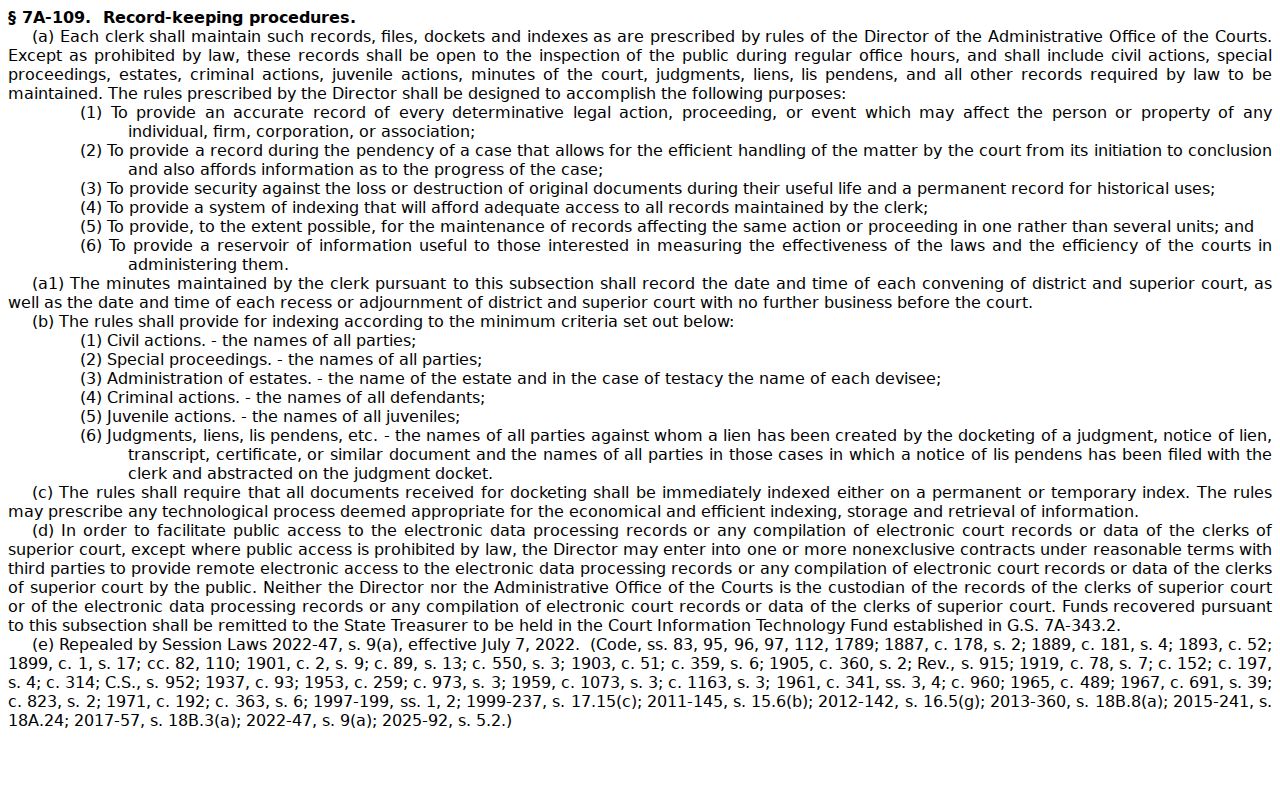
Public inspection still bends to whatever restrictions attach to a given Columbus County criminal record. The District Court overview describes the lower trial division that handles Columbus County misdemeanors and infractions.
That split in jurisdiction is what places a Columbus County criminal docket in the right court path.
The official expunction statute page is separate, but Recovery Courts matter here too. The Recovery Courts information describes statewide programs and does not create a separate Columbus County program docket.
No local program calendar or eligibility page exists for Columbus County, so check a Columbus criminal case through its underlying Columbus County Case Summary. The expunction statute also helps explain why some criminal records no longer appear publicly.
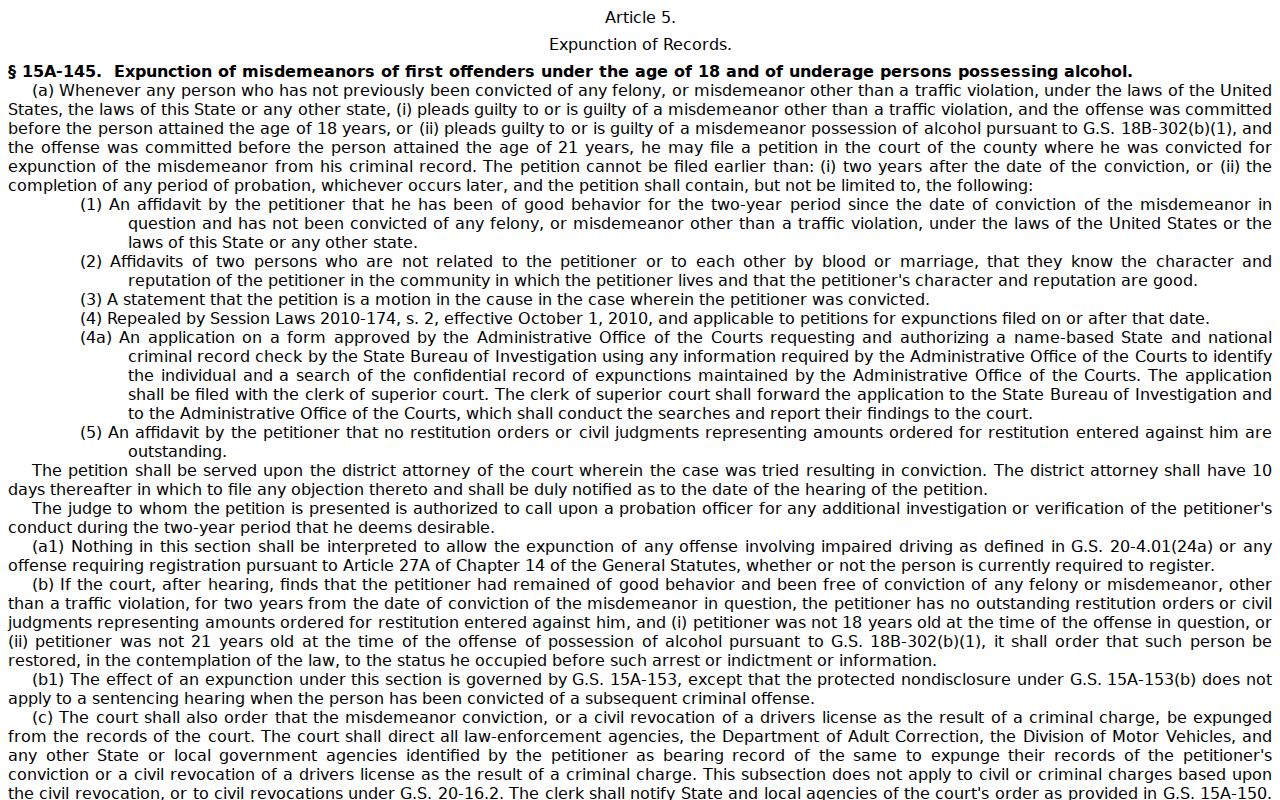
Eligibility and filing cost depend on which statute is invoked. The example fee is not a universal Columbus County charge.
The official route for county-level reporting is the criminal and infraction activity report, which the courts publish by county.
That report supports review of the current Columbus County caseload. It does not justify claims drawn from an unfiltered statewide total.